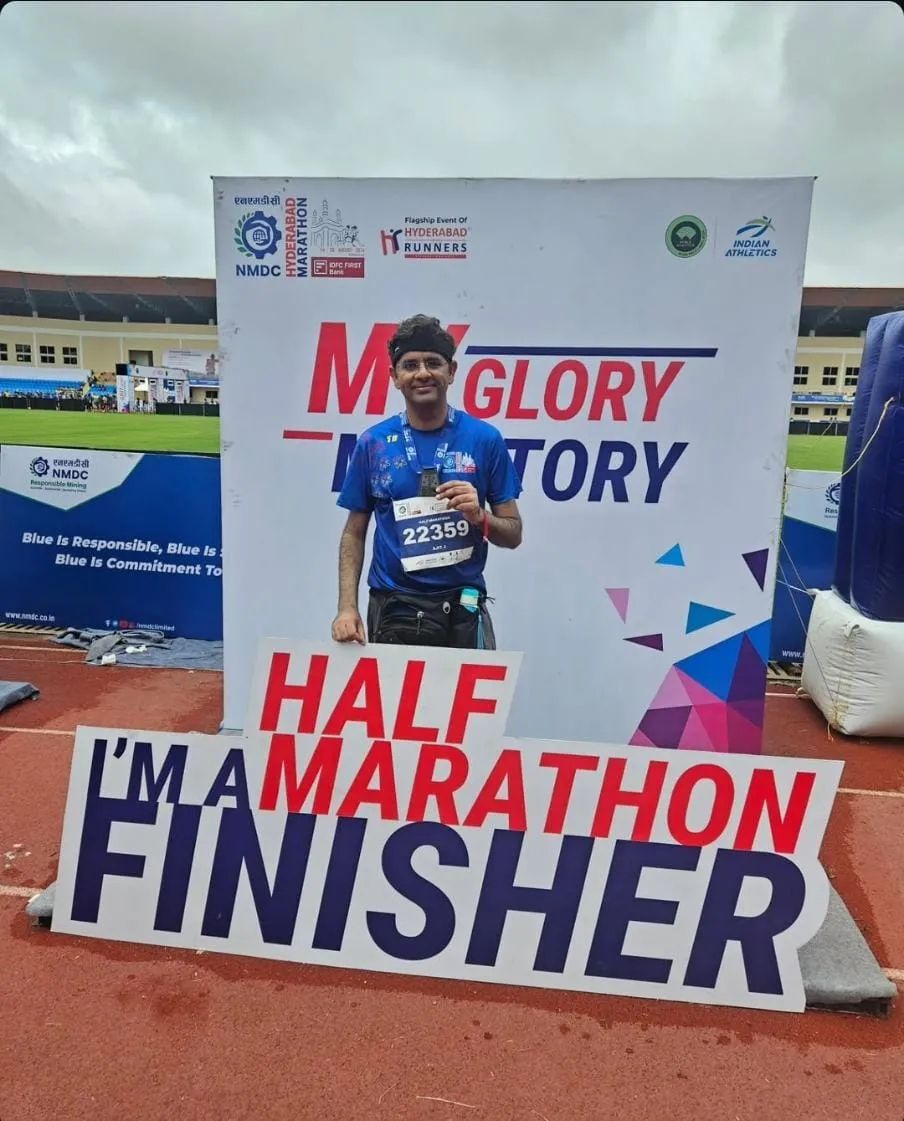
I have run 6 Half Marathons (2013, 2015, 2016, 2023, 2024, 2025 - Hyderabad only) and the first 12 km run in Indore (2009).
In this post, I will explore the nuances of Half marathon running, which are usually ignored by others.
Running a half marathon isn’t just about clocking 21.1 kilometres on a Sunday morning. It’s an endurance game test of mind, body and spirit. Somewhere between the start line and the finish arch, you don’t just run; you discover and appreciate many things.
Purpose
The key question is “What is your purpose of running a Half Marathon?”
There could be any combination of answers:
- Discovering your endurance and stamina, and learn more about your body
- Enhancing or maintaining your endurance/stamina
- Figuring out one’s endurance number over the years
- To experience achievement
- Build mental strength - it’s training the mind to push through fatigue, doubt, and struggle
- Answering the question of “if” you can do it
- Belonging to the tribe of “runners” / “community”
- For some, it is meditative and allows them to think about new and interesting perspectives.
- Discover places from new angles that you cannot see/observe from a car/ bike.
- Support cause(s)
- Getting a story to tell
- Showcase on Instagram and get likes
- Discover the variety in society - I discovered a 7-year-old ran a half marathon with his dad, a 70-year-old ran a half marathon, and an army guy running the entire half marathon in reverse with an Indian flag
- Network with a few interesting people in the marathon
- Discover/understand the community better (when you discuss with the organizers/information of number of runners - marathon wise/ category wise/ gender wise, age wise, etc.)
Preparation
There are multiple blogs talking about the practice runs, the importance of sleep, comfortable shoes, etc.I would like to tell you about the other smaller things that are usually not spoken about.
Here’s a list of things to take for a half / full marathon:
- T-shirt
- Bib
- Headband (to prevent sweat from falling from the forehead into the eyes)
- Shoes
- Hip pouch / Bag (to carry the below items)
- Water bottle
- Wallet
- Car keys
- Mobile
- Charged earbuds
- Music Playlist
Some key pointers:Never run with a new pair of shoes.
You should run only in practice shoes. This prevents improper fits for actual runs; the prior runs mould the cushioning to the shape of the leg and become more comfortable. A tight or a loose shoe can cause the toenails to be under pressure and cause pain.
Plan your run.
This means any combination of the following that you are planning to use:
- Run
- Jog
- Walk
- Break
This is where the practice runs help you to figure out what strategy best works for you with trial and error. Also, you need to determine how long you would be in one of the 4 modes before switching to the other mode.
Hydration Management
As you run, you should drink water/electrolyte juice to recharge yourself. Hydration management teaches balance. Too little, and you burn out. Too much, and you weigh yourself down.
Energy Management
Energy is a combination of food and water/electrolytes.
Food management is about fuelling smart, not just feeding hunger.
To each their own. But knowing and planning for it is compulsory.
Pace & Speed Management
Pace is Minutes per km. E.g. 9 minutes per km
Speed is Km/hr. E.g: 8 km/hr
What is your target at different milestones? What's your overall strategy depending on the terrain - flat, upwards, slopes?
There are multiple pacers in all marathons. A pacer is a runner who helps a set of runners set a certain pace. Which pacer are you going to run your race with?
Understanding and planning this is important.
Music Management
You want to be used to a particular music playlist in your practice runs to keep you in a similar rhythm and not get distracted while running the actual race.
2 Philosophies to Keep You Going
Lean forward: In the race, it means physically to bring the centre of gravity forward. In other aspects of life, it means looking at the positive side of things and being action-oriented.
Keep one leg in front of the other: In the race, it physically involves the smallest thing we need to do, “put one leg in front of the other”. In other aspects of life, it means doing the smallest activities to take things that don't need much thinking.
Risk & Crisis Management
Things don’t always go according to plan.
The parking place at the start may be changed or may be full. New road blockages may occur till you reach the planned parking place. Going an hr early is definitely a good de-risker for some of the above risks.
Cramp/pain? You endure
Rain? You adapt
Not well? You slow down, but you keep going.
Motivation slipping? You look inward and discover reserves you didn’t know you had.
Because at its core, the half marathon is not about distance—it’s about resilience.
The Finish Line & Beyond
Crossing the finish line isn’t just about medals or timing chips. It’s about proving to yourself that you can set a goal, struggle through the hard miles, manage your energy, and overcome crises, then still arrive, smiling, on the other side.
A half marathon is a mirror. It shows you who you are under pressure, in fatigue, and in triumph. It’s a reminder that the endurance game doesn’t end at 21.1 km. It continues in life, business, work, relationships and dreams.
So lace up, step out, and remember you’re not just running a half marathon; you’re discovering how far your endurance can take you in life.
Ajit J
Contributing author at Next Lap