For the longest time, if you wanted to run in Bangalore, you went to Cubbon Park. That was just the answer. Everyone knew it. Early mornings, the same familiar crowd, the same packed paths. If you lived in the north of the city, that also meant a 45-minute commute before you'd even laced up — which, for most people, was reason enough to stay home.
A few college students in Kothanur got tired of that math.
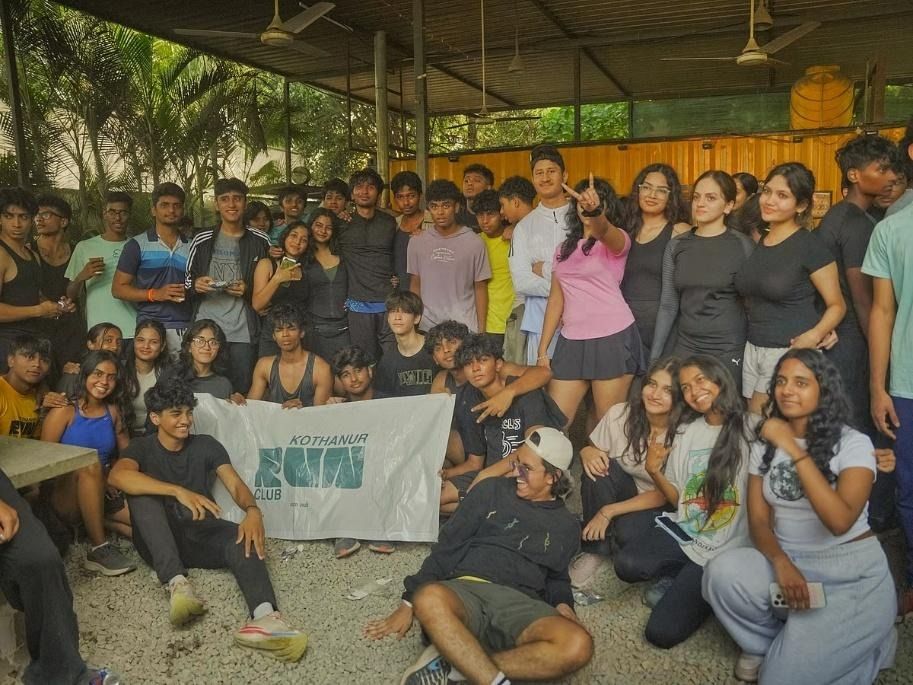
There was no grand plan. No pitch deck, no brand strategy, no founding manifesto. Just a pretty obvious thought: what if we ran here instead? So they did. Four of them, to start. The week after, twelve showed up. A month in, they'd crossed a hundred.
At its peak, a single Kothanur Run Club event drew over 2,400 people.
The founders were not athletes. They weren't fitness influencers with sponsorship deals or coaches with decades of experience. They were students — juggling coursework, part-time jobs, and the general chaos of being in their early twenties. Planning runs between lectures. Taking calls between classes. No polished gear, no marketing budget. Just a lot of energy and a group chat that kept growing.
What's striking isn't the scale they reached. It's how they reached it.
Most running communities are built around performance. Discipline. The grind. KRC went the other direction entirely. A typical session doesn't end when the run does — that's almost beside the point. After the run comes pickleball, or badminton, or everyone piling into a café and staying for two hours. One of the founders has said, pretty plainly, that running alone gets boring. So they made sure it never had to be.
The result was that people who had never once thought about their fitness started showing up. Not for the kilometers. For the hang.
There's something else worth noting about where this happened. North Bangalore had, for years, been absent from the city's fitness conversation. The running scene, the gym culture, the weekend warrior energy — that all lived in the south and the center. Kothanur Run Club didn't just build a community; it put a neighborhood on the map.
Once it started spreading, other clubs began forming across North Bangalore. Different vibes, different organizers, same basic impulse. KRC's founders didn't see that as competition. They saw it as the point.
The reach eventually went further than the city. Someone from Chennai attended a run, went home, and started their own club. People outside India had heard of it — not through any campaign or PR push, but through the reliable old engine of word of mouth. A good idea, spreading the way good ideas do.
It hasn't been without friction. Kothanur wasn't built for events of this size. The roads weren't designed for thousands of runners. So the club adapted — finding lakeside routes, quieter streets, cafés willing to partner up. They didn't wait for the right infrastructure. They worked with what existed and figured the rest out as they went.
That improvised, make-it-work quality is probably inseparable from what makes the club feel the way it does. There's no polish here, and that's not a flaw.
The founders will tell you they're not thinking about staying a run club forever. Running is the foundation, but the vision is wider — cricket, football, pickleball, a proper community sports ecosystem. They're aware that trends cycle. Running is having its moment, and they're smart enough not to assume the moment lasts forever.
What they're trying to build is something that outlasts the trend. A community that would have reasons to keep showing up even if running fell out of fashion tomorrow.
Whether they pull that off is an open question. But the fact that a group of college students, with no resources and no roadmap, managed to get 2,400 people to show up to a run in a neighborhood the rest of the city had ignored — that part already happened.
They didn't wait for perfect conditions. They just started running.
Team Next Lap
Contributing author at Next Lap