
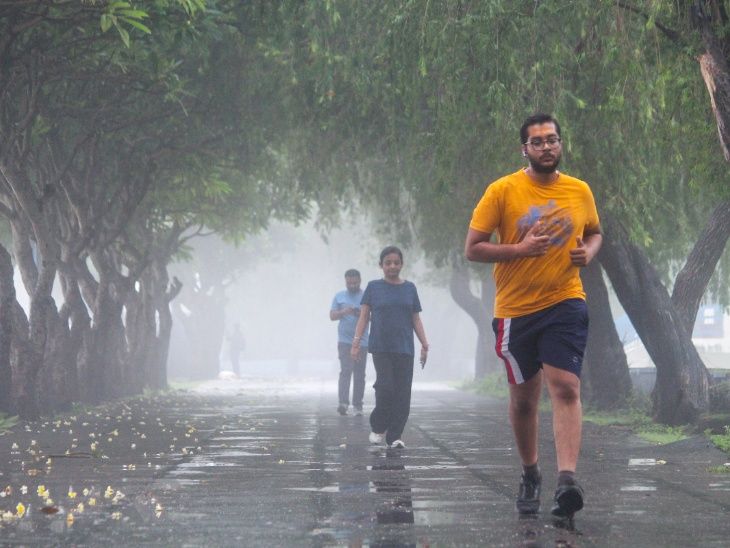
The sky is dark.
Your running shoes are ready.
Your training plan says easy 6K.
And then the rain starts absolutely throwing hands.
Welcome to running during the Indian monsoon.
For runners, the rainy season can be a strange mix of beautiful and mildly chaotic. One day you get cool, pleasant weather and the perfect running conditions. Next, your favourite route has turned into a collection of puddles, traffic is moving at approximately 4 km/h and your shoes are wetter than your post-run T-shirt.
So, should you stop running during the monsoon?
Not necessarily.
For most runners, the better approach is to adapt your training rather than abandon it.
With a little planning around weather, surfaces, hydration, footwear, recovery and workout intensity, the monsoon can actually become a useful part of your training year.
First Rule of Monsoon Running: The Weather Wins
Let's get one thing straight.
Being committed to your training does not mean you have to run through dangerous weather.
There’s a difference between running in a normal rain shower and heading outside during severe thunderstorms, lightning, flooding or conditions where visibility and road safety are compromised.
If the weather genuinely makes running unsafe, move your workout indoors or reschedule it.
Your training plan is not going to call the police because you missed one run.
Fitness is built over weeks and months.
One postponed session isn't going to erase it.
In fact, learning when not to run is part of becoming a smarter runner.
Should You Run in the Rain?
If conditions are safe, absolutely.
Running in light or moderate rain can be perfectly manageable, and some runners genuinely love it.
The cooler temperatures can make running feel more comfortable than a brutally hot summer session.
There is also something ridiculously satisfying about finishing a rainy run, getting home, showering and thinking:
“Okay, that was actually pretty fun.”
But monsoon running requires a little more awareness.
Wet roads can become slippery. Puddles can hide potholes. Muddy trails can become unstable. Visibility can drop quickly. Traffic conditions can change.
So don't just ask:
“Can I run today?”
Ask:
“Where can I run safely today?”
That tiny change in thinking can make a big difference.
Change Your Route When You Need To
Your usual running route might not be your best monsoon route.
Roads that are perfectly fine in dry weather can collect water during heavy rain. Trails can become muddy or slippery. Low-lying areas may flood. Footpaths can become difficult to navigate.
This is where being flexible with your route helps.
Maybe your usual 8K loop becomes a shorter road route.
Maybe you move to a track.
Maybe you choose an indoor treadmill.
Maybe you swap the outdoor run for cycling or another form of aerobic training when conditions are genuinely poor.
The goal is not to defend your favourite route at all costs.
The goal is to keep your training moving.
Slow Down on Wet Roads
Rain is not a secret invitation to practise your downhill racing skills.
Wet surfaces can reduce traction, particularly on painted road markings, tiles, smooth surfaces and certain types of pavement.
So if conditions are slippery, adjust your pace.
Shorter, controlled steps can help you stay more stable rather than trying to maintain your usual speed at all costs.
And pay attention to puddles.
That innocent-looking puddle may be two centimetres deep.
Or it may contain an entire missing section of road.
You don't know.
Your shoes definitely don't know.
Your Shoes Matter More During Monsoon
Your normal running shoes can still work during the rainy season, but you may need to pay more attention to traction, drainage and how quickly your shoes dry.
If you regularly run in wet conditions, having a second pair of running shoes can be incredibly useful.
That way, you're not waking up the next morning and discovering that yesterday's shoes are still sitting there like two damp pieces of regret.
After a wet run, remove the insoles if possible and let your shoes dry naturally in a well-ventilated area.
Avoid aggressively heating them, as excessive heat can damage materials and adhesives.
And please don't put your wet shoes away in a closed bag.
That is how your running shoes develop their own ecosystem.
Don't Forget Your Socks
Wet feet can become uncomfortable surprisingly quickly.
Choosing running socks that manage moisture well can help, and having a dry pair ready for after your run is one of those tiny monsoon habits that makes life considerably better.
If your feet regularly become irritated or develop hotspots during wet runs, don't simply ignore it.
Wet skin combined with friction can create problems that make your next few runs unpleasant.
Sometimes the smartest training decision is simply changing something small before it becomes a bigger issue.
Monsoon Running Doesn't Mean You Stop Hydrating
This one catches runners out.
It's raining.
It's cooler.
You're not sweating as obviously as you would on a hot summer day.
So you forget about hydration.
Your body, meanwhile, is still doing body things.
You can still lose fluid during exercise in cooler or wet conditions, particularly when humidity is high.
You don't necessarily need to carry the same amount of fluid for every short run, but your overall hydration routine should not disappear just because the sky is doing the watering.
For longer runs, pay more attention to your fluid needs, especially in warm and humid conditions.
Don't Let the Monsoon Turn Every Run Into a Hard Run
Rain can make running feel different.
You might run slower because of slippery surfaces, wind or puddles.
That's completely fine.
Your easy run doesn't suddenly become a failed workout because your pace is slower.
In fact, monsoon training is a good reminder that effort matters too.
If your training plan calls for an easy run, keep it easy.
If the weather makes your normal pace uncomfortable or unsafe, adjust.
Trying to force your usual pace through difficult conditions can turn a sensible session into an unnecessarily hard one.
Your watch might not understand the weather.
You should.
This Is Where Indoor Training Becomes Your Friend
You don't get bonus points for getting soaked.
If conditions are poor, move indoors.
A treadmill can keep your running consistent when roads become unsafe. Indoor cycling can help maintain aerobic fitness. Strength training can complement your running while giving your legs a break from repetitive impact.
The point isn't to perfectly recreate every outdoor workout.
It's to preserve the purpose of the session.
If your goal was an easy aerobic run, find a safe way to get that aerobic work done.
If the goal was strength, strength training still works.
Training is about the adaptation you're trying to create, not simply ticking a box that says “ran outside.”
Monsoon Is Actually a Great Time to Build Consistency
Here's the underrated part.
Training through imperfect weather can teach you flexibility.
You learn to adjust your route.
You learn to manage effort.
You learn when to move indoors.
You become better at planning around weather instead of expecting perfect conditions every time you run.
And that matters because race day isn't going to ask whether the weather was convenient during your training cycle.
Your training doesn't need perfect conditions.
It needs consistency.
That doesn't mean running through every storm.
It means learning how to keep moving when conditions are less than ideal.
Don't Forget Strength and Mobility
If heavy rain is disrupting your outdoor running schedule, use some of that time intelligently.
Strength training can complement your running and help develop the muscles involved in producing and controlling movement.
A simple routine built around exercises such as squats, lunges, calf raises and core work can fit alongside a running programme.
Mobility work can also be useful, particularly if you're spending more time indoors or reducing your running volume temporarily.
Think of monsoon as an opportunity to work on the pieces of your training that sometimes get ignored when you're busy chasing kilometres.
Follow a Plan Instead of Guessing Your Way Through the Season
The monsoon can make training unpredictable.
That is exactly why having a flexible training plan can help.
A good plan gives you the overall structure while leaving room to move sessions around when weather conditions change.
Maybe your long run moves from Sunday to Monday.
Maybe a speed session becomes a treadmill workout.
Maybe an outdoor run becomes an indoor aerobic session.
The plan doesn't disappear.
It adapts.
And if you're training towards a half marathon, marathon, trail race or another endurance event, having that bigger picture can stop one rainy week from turning into a month of inconsistent training.
This is also where a running coach can help.
A coach can adjust your training based on weather, fatigue, race goals and how you're actually responding to the workload rather than expecting you to blindly follow a calendar.
Monsoon Training Is About Being Smart, Not Hardcore
There's a strange culture around running where suffering sometimes gets treated as proof that you're serious.
Let's retire that idea.
You don't need to run through lightning to prove you're committed.
You don't need to finish every workout at your target pace when the road is flooded.
You don't need to sacrifice safety because your training app says “6K remaining.”
Good runners aren't just tough.
They're adaptable.
They know when to push.
They know when to slow down.
And they know when the correct training decision is to stay indoors and do something else.
Your Monsoon Running Checklist Is Actually Pretty Simple
Keep your routes flexible.
Watch the weather.
Choose safer surfaces.
Slow down when conditions demand it.
Look after your shoes and feet.
Stay hydrated.
Use indoor training when necessary.
Keep strength and recovery in the mix.
And most importantly, keep your overall training consistent.
If you're following a structured programme, don't panic when one session changes.
The purpose of training is to prepare you for your goal over time.
Not to create a perfect screenshot for your fitness app.
Ready for Your Next Race?
Monsoon doesn't have to be the season where your running routine disappears.
It can be the season where you become a smarter runner.
Build the aerobic base.
Work on strength.
Keep your easy runs easy.
Learn to adapt.
Then, when race season rolls around and everyone suddenly remembers they have a marathon to train for, you'll already have a few months of consistent work behind you.
If you want more structure, Next Lap offers training plans and training camps to help runners train with guidance, progression and a little less guesswork.
And when you're ready to put all that monsoon mileage to work, you can start looking for your next race on Next Lap.
Because the rain may mess with your running schedule.
It doesn't have to mess with your running goals.
Team Next Lap
Contributing author at Next Lap